

1. Background: Strikes on Iran (June 21–22, 2025)
On June 21, President Trump authorized precision airstrikes targeting three Iranian nuclear facilities—Fordow, Isfahan, and Natanz—in coordination with Israel. He labeled it “Operation Midnight Hammer” and claimed it had “completely obliterated” Iran’s enrichment capacity reuters.com+8news.com.au+8politico.eu+8washingtonpost.com+1reuters.com+1news.com.au+5conference-board.org+5washingtonpost.com+5lemonde.fr+13apnews.com+13cfr.org+13time.com+1thesun.co.uk+1.
These were not conventional sorties but 125 combat aircraft, including U.S. B‑2 stealth bombers carrying Massive Ordnance Penetrators to penetrate subterranean bunkers cfr.org. Satellite imagery later revealed significant underground damage and collapse of tunnel systems apnews.com+1cfr.org+1.
While Trump credited the strikes with delaying Iran’s nuclear threat, the Pentagon acknowledged the full impact remains under assessment thesun.ie+15apnews.com+15time.com+15.
2. NATO Summit’s Intended Agenda
The two‑day NATO summit in The Hague, set to begin June 24, was originally crafted to concentrate on:
- Enshrining a defense spending target of 5 % of GDP, with 3.5 % on hard defense and 1.5 % on broader security infrastructure apnews.com+7ft.com+7washingtonpost.com+7reuters.com+1thedailybeast.com+1.
- Encouraging stronger deterrence against Russian aggression, especially in light of ongoing pressure in Ukraine .
- Delivering a tightly structured summit—one working session, minimal communiques, plus a royal-state dinner—designed to avoid surprises apnews.com+9politico.eu+9reuters.com+9.
Alliance leaders sought a short, “punchy” agenda to minimize the risk of derailment by Trump’s unpredictability thedailybeast.com+3politico.eu+3washingtonpost.com+3.
3. Immediate Iranian Retaliation
As early as June 23, Iran launched a missile attack on Al‑Udeid Air Base in Qatar, the largest U.S. military installation in the Middle East reuters.com+11conference-board.org+11en.wikipedia.org+11.
Though no casualties were reported and Qatar’s air defenses intercepted the missiles, the strikes were Iran’s first direct military reply en.wikipedia.org. Trump referred to it dismissively as “a very weak response,” but it nonetheless signaled that tensions had entered a dangerous new phase en.wikipedia.org+1newsweek.com+1.
Iran threatened “everlasting consequences” if further aggression continued cfr.org+9time.com+9conference-board.org+9. U.S. officials, including DHS, warned of potential retaliatory cyberattacks.
4. European Sum-up: Mixed Reactions
France
President Macron denounced the U.S. strikes as unlawful—“no legality to them”—though he reiterated that diplomacy remained the only viable solution apnews.com+1reuters.com+1lemonde.fr+10washingtonpost.com+10apnews.com+10.
United Kingdom
PM Keir Starmer provided cautious backing, emphasizing Iran’s nuclear threat while committing to regional protection. He confirmed the UK had been notified—but did not directly participate—in the strikes thesun.co.uk.
Germany
Split responses emerged: some conservatives supported the strikes to curb Iran’s nuclear ambitions; others warned of escalation and legal concerns .
EU Summit
The E3 foreign ministers (UK, France, Germany) sought to de‑escalate. Their Geneva talks with Iran ended without agreement, and Iran refused to negotiate under military pressure apnews.com+1responsiblestatecraft.org+1.
Global Voices
World leaders—from China, UAE, Qatar, Japan, Italy, New Zealand, and Pakistan—called for immediate diplomacy and restraint, warning of violation of international law and broader instability .
The UN Secretary-General António Guterres called the strikes a “dangerous escalation” and urged urgency in diplomatic engagement reuters.com+1en.wikipedia.org+1.
5. Transatlantic Trust Under Strain
This marks another fracture in the U.S.–Europe relationship:
- Unilateral Strike: Trump’s decision, without formal NATO consultation, reopens debates over NATO-centralized command versus unilateral military action .
- Historic Rifts: Trump’s repeated criticism of NATO members’ spending, threats to withdraw U.S. troops from Europe, and tariff threats have eroded trust apnews.com.
- European Independence: With mistrust rising, European states are pursuing more autonomous defense—focusing on capabilities in air defense, space, and cybersecurity ft.com.
6. Broader Global Implications
⚠️ Risk of Wider Conflict
Iran’s posture—threatening further action but cautious to avoid full war—puts Gulf states and sea lanes at risk .
Russia has reportedly discussed exploiting the instability to threaten NATO’s eastern flank, according to Ukraine’s warnings thesun.ie.
🌐 Economic Disruptions
Even a brief interruption in Middle Eastern oil and trade routes like Hormuz could drive price spikes and shocks to global markets.
🚫 Diplomatic Breakdown
After Julian Geneva talks with Iran fell apart, Moscow offered to mediate. Still, Tehran has so far refused continued negotiation due to military pressure apnews.com.
7. Protests & Public Mood
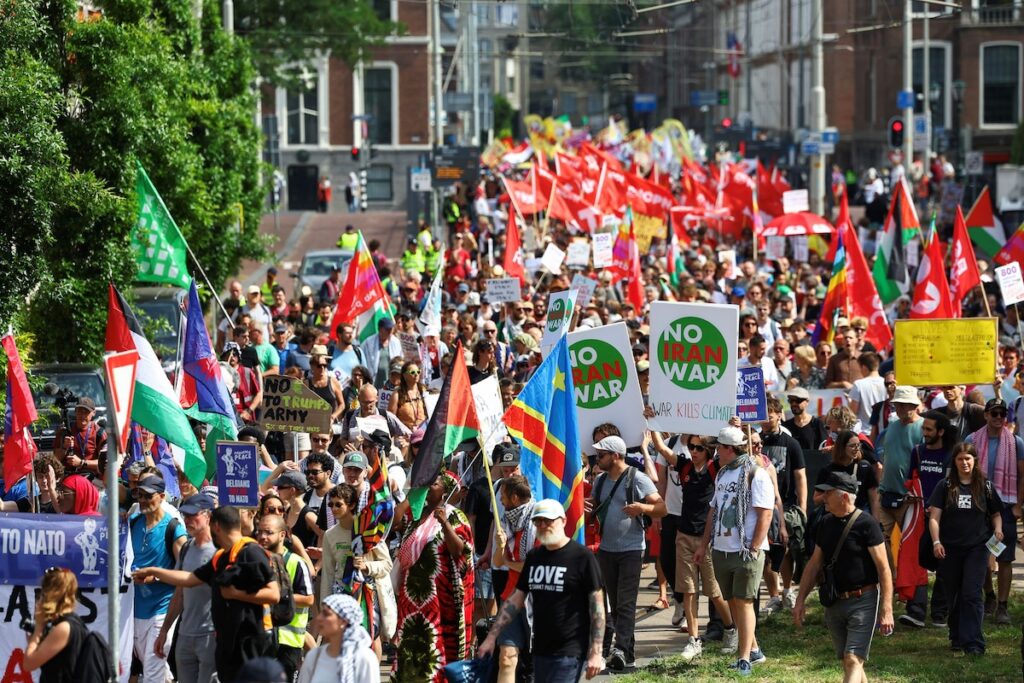
The Hague saw mass protests on June 22, mobilizing against NATO’s increase in military expenditure and opposing escalation with Iran. Demonstrators carried banners like “No Iran War” and called for investing in peace and sustainable energy instead .
Organizers estimated around 5,000 participants near the Peace Palace—reflecting wide concern among European civil societies reuters.com.
8. Summit Takeaways & Forecast
Summit Adjustments
Mark Rutte confirmed that while Iran won’t be a formal agenda item, its effects will hang over discussions ft.com+4washingtonpost.com+4apnews.com+4.
Spending Agreement
NATO appears ready to commit to 3.5% GDP on core defense and 1.5% on related infrastructure, with a 10-year implementation timeline. However, Spain remains hesitant thedailybeast.com+2ft.com+2reuters.com+2.
Alliance Strategy
Expect confirmation of mutual defense (NATO Article 5), and a shift toward greater European defense integration—particularly in air defense, cyber, and space ft.com.
Risk Track
Track missile-lane tensions in the Gulf, watch Iran’s next retaliation, and eye Russia’s broader maneuvers and cyber provocations apnews.com+1theguardian.com+1.
9. Why It Matters for Venzec Readers
- Geopolitical Insight: Learn how one nation’s military move can pivot global summit objectives and reshape alliance politics.
- European Perspective: Analyze how France, Germany, and the UK reconcile divergent security strategies under pressure.
- Security Strategy: Discover how NATO’s future may tilt toward European defence autonomy due to pushback against U.S. unilateralism.
- Public Sentiment: Civil protests reveal rising anti-war, pro-peace sentiments within Europe.
- Economic Alert: Understand the potential ripple effects on energy prices and global market stability.
10. Final Thought
As NATO leaders meet in The Hague, the original plan to reinforce collective defense and military readiness faces an unexpected test: whether Europe can respond to U.S.–Iran tensions with unity, restraint, and forward-looking strategy—or if transatlantic bonds will fray further, reshaping military alliances for years.







Leave a Reply